
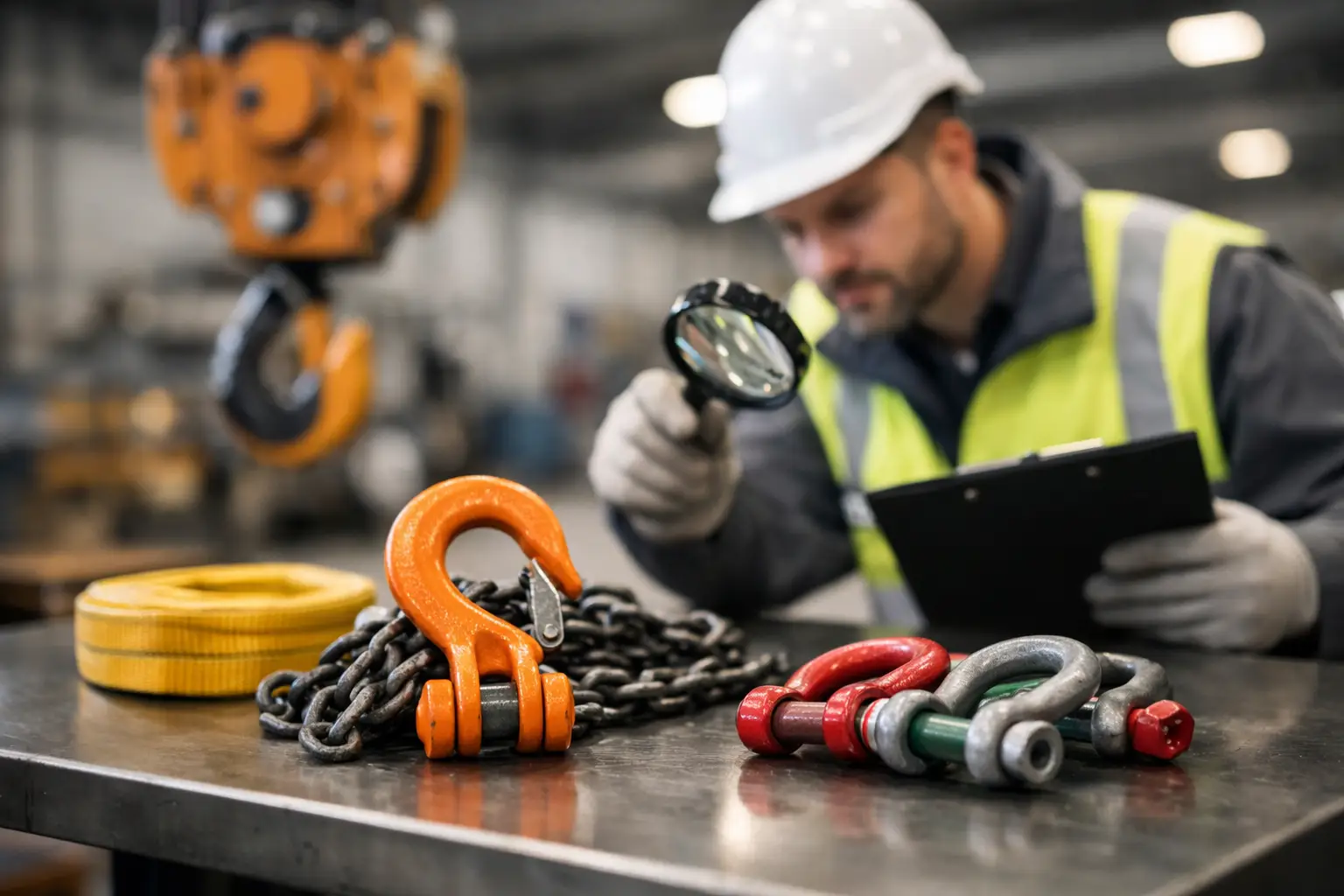
A lifting sling can look serviceable after months in use, then fail because of damage hidden beneath a protective sleeve or a deformation missed during a rushed check. That is why the question of when are lifting accessories examined is not an admin detail. It is a core control for preventing dropped loads, enforcing safe systems of work and proving compliance when a client, insurer or regulator asks for evidence.
For UK dutyholders, the main legal framework is the Lifting Operations and Lifting Equipment Regulations 1998 (LOLER). The default requirement is clear: lifting accessories must receive a thorough examination at least every six months. But a calendar interval alone is not enough. First-use requirements, exceptional circumstances, written schemes of examination and day-to-day inspection all affect what a compliant programme looks like in practice.
When are lifting accessories examined under LOLER?
Under LOLER Regulation 9, lifting accessories must be thoroughly examined by a competent person at intervals of no more than six months. This applies to equipment used to attach a load to lifting machinery, including common items such as chain slings, wire rope slings, textile slings, shackles, eyebolts, lifting beams, lifting clamps and spreader beams.
The six-month interval is the standard route, not a target to drift past. If an accessory was thoroughly examined on 10 January, the next examination must be completed by 10 July at the latest. Inspection firms and their clients should plan well ahead of that due date, particularly where assets are distributed across construction sites, workshops, depots or customer premises.
A competent person can instead specify a written scheme of examination. This is a formal document that sets out the examination scope and frequency for defined equipment, based on its condition, use and operating environment. The scheme may prescribe a different interval where it provides an equally safe and suitable regime. It is not a blanket excuse to extend dates without technical justification.
Before first use
A lifting accessory should also be thoroughly examined before it enters service, unless a valid exemption applies. Where equipment is supplied with a declaration of conformity and has not been used before, a further examination may not be required before first use, provided the declaration was made within the relevant 12-month period. The dutyholder should verify the documentation, asset identity and intended use rather than assuming a supplier certificate covers every circumstance.
This is particularly relevant when a contractor brings new accessories onto a site. Procurement records, declarations of conformity and the first examination date need to be connected to the individual asset. A box of visually identical shackles with one shared document is difficult to defend if serial numbers, safe working loads and locations cannot be traced.
After exceptional circumstances
LOLER also requires a thorough examination following exceptional circumstances that could jeopardise safe use. Examples include an overload, a shock load, a lifting incident, a dropped load, exposure to fire or corrosive chemicals, unauthorised repair, significant damage in transit, or a long period out of service where condition is uncertain.
The correct response depends on the event and the equipment involved. A pre-use visual check may identify obvious damage, but it does not replace a competent person’s thorough examination where an exceptional circumstance has occurred. The accessory should be quarantined, clearly marked to prevent use and assessed before being returned to service.
Thorough examination is not the same as a pre-use check
This distinction causes avoidable compliance gaps. A thorough examination is a detailed statutory examination by a competent person. It considers the accessory’s condition, suitability, markings, wear, distortion, cracks, corrosion and any defects that could affect safe operation. The examiner must produce a report of thorough examination.
Pre-use checks are operational checks carried out by the person using the equipment, normally before each shift or lifting task. They are a practical first line of defence. A slinger or appointed person may check that an item is correctly identified, within date, clean, free from obvious damage and suitable for the planned load and lifting arrangement.
Routine inspections may sit between these two activities, especially in high-use or harsh environments. Textile slings used outdoors, chains exposed to abrasive materials, or accessories operating in marine, chemical or foundry environments may need closer monitoring than equipment stored and used occasionally in a controlled workshop. The legal examination interval is a maximum. Risk may justify more frequent checks.
What the competent person must assess
A competent person needs sufficient practical and technical knowledge of the accessory type, the likely defects and the conditions in which it is used. They must also be sufficiently independent and impartial to make an objective judgement. This does not always mean an external provider, but the person must have real authority to condemn equipment where necessary.
During examination, the assessor will typically verify identification and markings, including the safe working load, and look for wear, elongation, damaged stitching, broken wires, corrosion, heat damage, cuts, deformation and incompatible components. They will consider whether the accessory remains suitable for its intended configuration, not merely whether it appears intact on the floor.
For example, a multi-leg chain sling may be physically undamaged but incorrectly tagged, missing a component or routinely used at an angle that changes its lifting capacity. Compliance is about safe use as well as physical condition. Asset records should therefore capture the accessory type, serial number or unique ID, WLL, location, status, examination interval and any restrictions applied by the examiner.
Reports, defects and the 28-day rule
Following every thorough examination, the dutyholder must receive a written report. This must contain prescribed information under LOLER, including identification of the equipment, the date of examination, the date the next examination is due, defects found and whether those defects create a danger.
Where the competent person identifies a defect involving an existing or imminent danger, they must report it immediately to the dutyholder. They must also send a copy to the relevant enforcing authority. That process needs to be supported by a clear field workflow: isolate the asset, record the defect, notify the responsible person and prevent accidental reissue.
Reports of thorough examination must be retained for at least two years, or until the next report is made where that period is longer. If equipment is hired out, moved between sites or managed by a contractor on behalf of multiple clients, the report must remain accessible to the people responsible for its use. A certificate trapped in an engineer’s inbox or a paper folder at the wrong depot is not operational control.
Managing lifting accessory examinations across a client estate
The hardest part for inspection firms is rarely understanding the six-month requirement. It is maintaining control when hundreds or thousands of accessories move across changing sites, crews and contracts. Missed dates often start with weak asset data: duplicate records, unidentified items, incomplete test certificates or accessories logged only as a quantity rather than individual assets.
A controlled workflow begins by building an accurate asset register. Each accessory should have a unique identity, current location, examination history, due date and supporting evidence. Engineers need that information on mobile devices while on site, including offline where connectivity is unreliable. They should be able to complete the examination against a standardised defect catalogue, capture photographs and signatures, issue the report and immediately update the asset status.
For operations teams, the priority is forward planning. Schedule work before due dates, group assets by site or client, allocate competent engineers and monitor certificates that remain incomplete after a visit. Defects should trigger follow-up actions, not disappear into a PDF. Where an item is condemned, its status must be visible to field teams, planners and the client.
CertFlow supports this type of asset-led LOLER workflow by bringing registers, mobile inspection forms, due-date scheduling, defect evidence and certificate records into one audit-ready system. The practical gain is not simply faster paperwork. It is the ability to show exactly what was examined, when it was examined, who made the decision and what happened next.
A practical approach to keeping examinations on time
The most reliable programmes separate statutory due dates from operational reminders. Set internal alerts far enough ahead to allow for access issues, customer approvals, engineer availability and failed appointments. For critical or widely dispersed estates, staged reminders at 90, 60 and 30 days can prevent last-minute scheduling.
Do not treat all lifting accessories as interchangeable. Match each record to the actual item, its use and its environment. Review records after incidents, changes in lifting operations and periods of storage. If the competent person recommends a revised interval, restriction or repair action, make that decision visible in the live asset record rather than relying on someone to read the report later.
A six-month thorough examination is the minimum rhythm for most lifting accessories under LOLER. The stronger operational standard is simpler: every item is identifiable, every due date is planned, every defect is closed out and every certificate can be produced when it is needed.