Electrical

EICRs, fixed-wire testing and PAT, captured on site, certified in minutes.

BS 7671Electricity at Work Regs 1989IET Wiring RegulationsEICR

Run BS 7671 electrical inspections end to end: a guided EICR workflow, offline circuit testing, observation coding and instant branded certificates.

app.certflow.co.uk
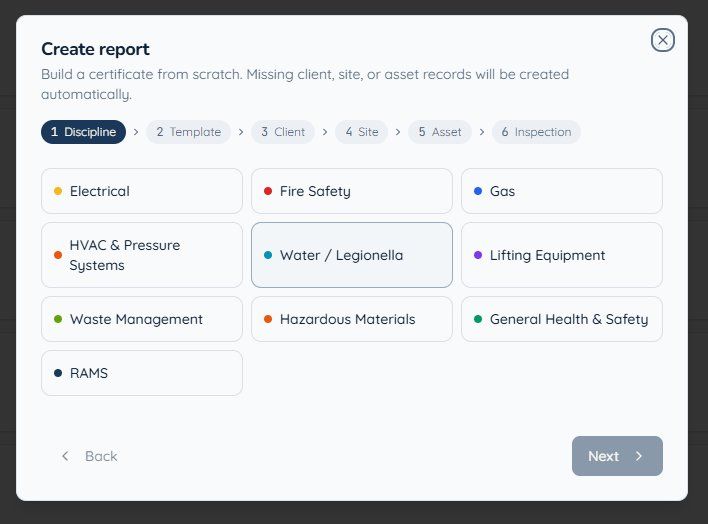
CertFlow report wizard including Electrical

The duty

What Electrical compliance involves.

Electrical compliance in the UK is governed by BS 7671 (the IET Wiring Regulations), the Electricity at Work Regulations 1989 and, for landlords, the Electrical Safety Standards in the Private Rented Sector. Every fixed installation must be inspected and tested at regular intervals, with results recorded on an Electrical Installation Condition Report (EICR).

For inspection firms the hard part is rarely the testing, it is the paperwork. Scheduling EICRs across hundreds of distribution boards, capturing circuit-by-circuit results in the field, coding observations C1 to C3, and producing a defensible certificate the same day.

CertFlow gives engineers a guided EICR workflow on mobile, generates a branded BS 7671 certificate in minutes, and files it automatically in a searchable registry, so you can prove compliance the moment a client, insurer or enforcement officer asks.

Your legal duties

What the regulations require.

01

Periodic inspection & testing (EICR)

Fixed installations must be inspected and tested at intervals recommended by BS 7671, commonly up to every 5 years for commercial premises and at change of occupancy. Results are recorded on an EICR using observation codes C1, C2, C3 and FI.

02

Electricity at Work Regulations 1989

Duty holders must maintain electrical systems, so far as is reasonably practicable, to prevent danger, and keep records showing that maintenance was carried out by competent persons.

03

In-service inspection (PAT)

Portable and transportable equipment is inspected and tested under the IET Code of Practice on a risk-based frequency. CertFlow tracks every appliance, its history and its next-due date.

04

Private rented sector (England)

Landlords must ensure fixed installations are inspected at least every 5 years and supply the report to tenants and, on request, the local authority within strict deadlines.

How CertFlow handles it

From due date to defensible certificate.

Electrical runs on the same platform as every other discipline, so the workflow, the registry and the audit trail are identical, whatever your team inspects.

Ready-to-issue templates

A built-in BS 7671 report template, plus a drag-and-drop builder and bespoke PDF overlay for any client-specific form.

Automatic scheduling

Put every electrical asset on a recurring examination cycle. CertFlow generates the jobs and warns you before anything falls due.

Captured on site, offline

Readings, photos and signatures are captured in the field on mobile, fully offline, and sync the moment a connection returns.

Audit-ready proof

Every electrical certificate is filed in a searchable, exportable compliance registry with a full timestamped history.

From the field

What inspectors commonly find.

The defects and gaps that come up again and again on electrical inspections, the ones a good system helps you catch before an auditor does.

  • Missing or inadequate RCD protection on final circuits
  • Absent or undersized main protective bonding to gas and water
  • Signs of overheating or thermal damage at terminations and in consumer units
  • No circuit identification, or board labelling that no longer matches reality
  • Borrowed neutrals and past alterations carried out without certification

Why it matters

Penalties & enforcement.

Breaching the Electricity at Work Regulations 1989 can bring HSE improvement and prohibition notices, prosecution and unlimited fines, as well as invalidated insurance. In the private rented sector in England, local authorities can fine landlords up to £30,000 for failing to hold a valid EICR.

Free download: the Electrical duty-holder guide

Questions

Electrical on CertFlow, answered.

Does CertFlow produce a compliant EICR?

Yes. CertFlow ships with a BS 7671 model EICR template covering installation details, the schedule of inspections, the schedule of test results and observation coding. Engineers complete it on mobile and the system outputs a branded PDF.

Can engineers record circuit test results offline?

Yes. The mobile app works fully offline. Circuit-by-circuit results, Zs/Ze readings, RCD trip times and observations are captured on site and sync automatically when a connection returns.

How are observation codes and remedials handled?

Each observation is coded C1, C2, C3 or FI and can be turned into a remedial job in one tap, scheduled to an engineer and tracked through to a satisfactory re-test.

Can I track PAT alongside fixed-wire testing?

Yes. PAT assets live in the same register as fixed installations, each with a risk-based retest interval, full history and a QR label for instant lookup in the field.

PDF · A4

Duty Holder’s Guide to Electrical Safety (EICR)

What the law expects for fixed electrical installations, and where the EICR fits, in plain English.

Get your free copy

No spam. Unsubscribe any time. See our privacy policy.

References

Electrical: official sources

Links to primary UK legislation and official regulator guidance. CertFlow is independent and not affiliated with these bodies.

See it on your data

Run your first electrical report in the demo.

We'll set up a live environment with your asset types and branding, then walk you through a BS 7671 job end to end.

Book a 20-min demo

Get started

Replace the spreadsheet before your next audit.

See CertFlow on your own data in a 20-minute demo, or start a free trial today.