
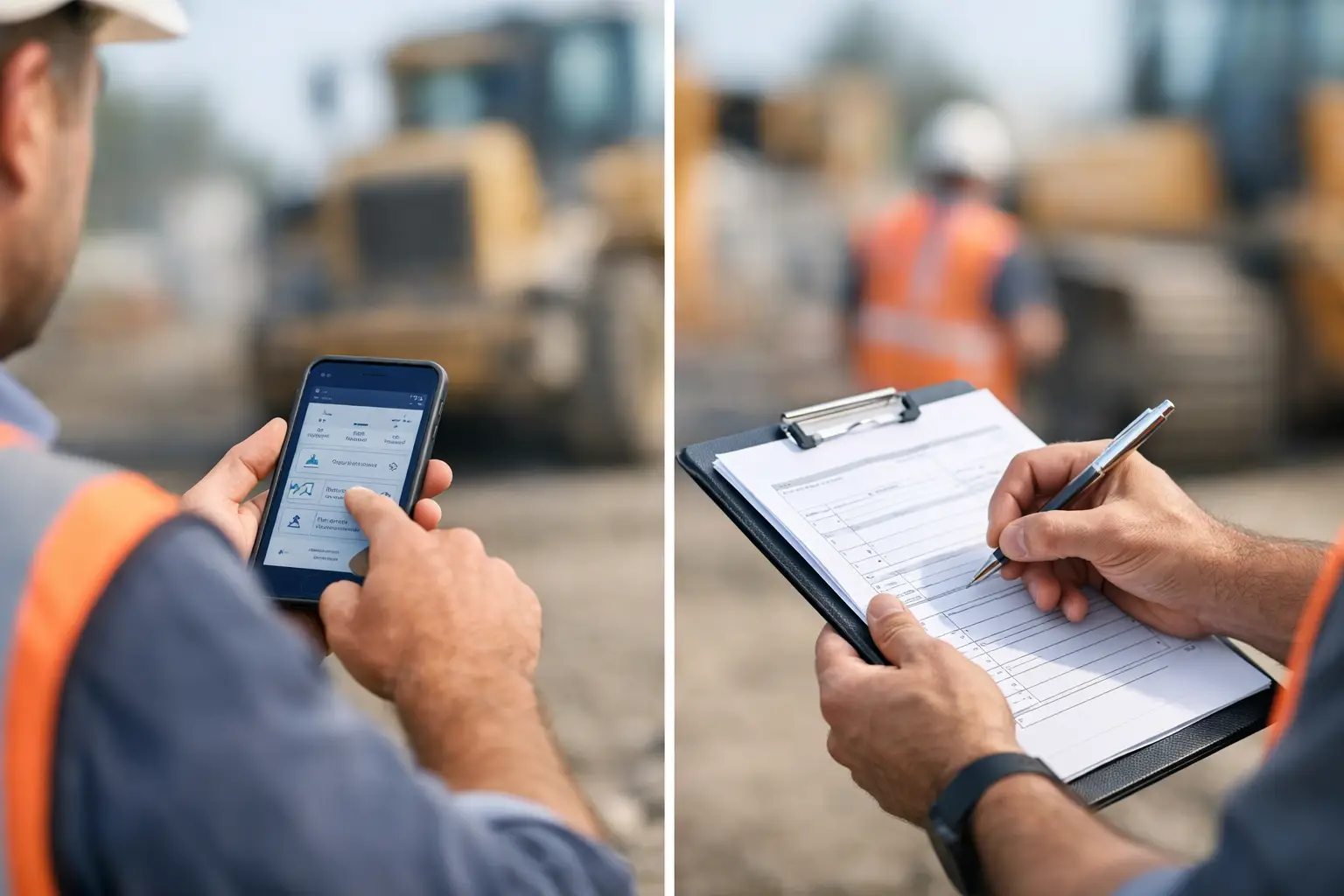
A lifting inspection completed on a damp plant room floor can look perfectly acceptable on a paper form. The problem appears later: a serial number is illegible, a defect note is incomplete, the sheet is still in an engineer’s van, and the certificate cannot be issued until someone rekeys it. The field engineer app vs paper forms decision is therefore not simply about replacing a clipboard. It is about the speed, consistency and traceability of your entire compliance operation.
For UK inspection firms managing LOLER thorough examinations, fire risk work, electrical testing, legionella monitoring or planned maintenance, paperwork is often familiar but expensive. A field app can remove avoidable administration, but only when it reflects the actual workflow engineers and operations teams need to run.
Field engineer app vs paper forms: the operational difference
Paper forms put the work record in the field, but they do not connect it to the wider job. The engineer records findings, then the office has to interpret handwriting, enter asset details, chase missing information, build a report and file evidence. If an asset register sits in a spreadsheet and scheduling sits elsewhere, every handover creates another opportunity for delay or error.
A purpose-built field engineer app treats the inspection as one controlled workflow. The engineer opens the scheduled visit, sees the relevant site and assets, completes the correct inspection template, records defects against the individual asset and captures photographs, signatures and timestamps. The information is then available to the office without a separate transcription stage.
That distinction matters most where work is recurring. A PUWER check is not a one-off document. It is part of an asset history, a future inspection cycle, a client compliance record and, often, a commercial relationship that depends on timely certification. Paper can document an event. A properly configured app manages the process around it.
Audit evidence is where paper usually falls short
Paper is not automatically non-compliant. A well-designed form, completed properly and stored securely, can support a compliant inspection record. The operational question is whether your business can consistently prove what happened, when it happened, who completed it and whether the record has been changed after the event.
For regulated work, that evidence needs to stand up to scrutiny. A client may request the latest report for a pressure system. An insurer may ask for historical examination records. A regulator may need evidence that a defect was identified, communicated and subsequently addressed. Locating a scanned document is not the same as maintaining a traceable record.
A field app can create an auditable chain of evidence as work is completed. Time and date stamps, engineer identity, location data where appropriate, client signatures, photographs and defect status can sit alongside the asset record. This reduces the reliance on memory, filing discipline and manually named documents.
The benefit is not only for an external audit. It gives technical managers a clearer view of whether engineers are using the right template, recording sufficient evidence and applying defect classifications consistently. Audit-ready by default is a stronger operating position than trying to reconstruct a record when a question arrives.
Standardisation improves engineering quality
Inspection firms rarely struggle because their engineers lack technical knowledge. More often, inconsistency creeps in because forms vary by contract, legacy templates have been copied for years, or individual engineers record findings in different ways.
Paper encourages this variation. An engineer may skip a non-applicable section without noting why, use an unclear defect description or write an observation that the office later has to interpret. Those gaps can affect certificate quality and make trend reporting unreliable across a large asset estate.
An app can present discipline-specific inspection points and approved defect catalogues at the moment they are needed. For example, a lifting engineer can be guided through the relevant LOLER examination record, while a fire service engineer uses checks that reflect the equipment and service scope on that site. Mandatory fields can prevent an inspection being closed with key information missing.
This should not turn experienced engineers into box-tickers. The best systems leave room for engineering judgement, detailed observations and site-specific evidence. They simply make the minimum standard clear and repeatable. That is particularly valuable when onboarding new engineers, subcontractors or teams following an acquisition.
Faster certificates without cutting corners
The delay between field completion and client delivery is one of the clearest costs of paper forms. An engineer may finish a job on Friday, submit paperwork the following week and wait for an administrator to process it. If a client needs a certificate before equipment can return to service, that delay becomes a commercial problem rather than an admin issue.
With digital field completion, certificates and reports can be generated from validated inspection data. The office can review exceptions rather than re-enter every result. Defects can be highlighted, professional client-facing documents can be issued sooner and completed work can move towards invoicing without waiting for a pile of paperwork.
Speed still needs control. Not every report should be released automatically. High-risk defects, unusual findings and reports completed by less experienced engineers may require technical review. The advantage of an app is that review can be built into the workflow, with clear approval stages and an accessible evidence trail, rather than relying on an email or a paper tray.
Offline working is not optional in the field
One common objection is practical: engineers work in basements, plant rooms, rural sites and industrial facilities where signal is unreliable. A browser-only system that fails without mobile data is not a replacement for paper.
This is where offline capability matters. Engineers should be able to access assigned jobs, asset data and inspection forms without a connection, complete the work normally, and sync when coverage returns. The process must be dependable enough that the engineer does not need to carry duplicate paper forms “just in case”.
Paper has a genuine advantage in one narrow scenario: it never needs charging. Any move to mobile working needs device policies, charging arrangements, support for damaged hardware and a clear approach to data security. These are manageable operational requirements, but they should be planned rather than ignored.
The real cost is not the price of paper
A printed form is cheap. The process behind it is not. Consider the time spent printing packs, carrying files, chasing missing sheets, scanning documents, rekeying asset details, correcting errors and answering clients who need a certificate that has not yet been processed. Then consider the risk of a missed inspection date because the asset register was not updated in the same place as the field record.
The case for a field app becomes stronger as job volume, site count and asset numbers increase. A small firm completing occasional inspections may find paper workable for longer, particularly if its workflow is simple and the same people inspect, review and issue documents. A multi-engineer operation covering recurring statutory programmes will usually reach the point where manual handovers constrain growth.
Measure the current process before choosing a system. Track the average time from job completion to certificate issue, the number of forms returned with missing information, office hours spent on rekeying, and overdue inspections caused by incomplete asset data. These figures make the operational cost visible and provide a realistic baseline for change.
Choosing an app that fits inspection work
A generic forms tool may capture answers, but it can still leave the business juggling schedules, spreadsheets, report templates and shared folders. For inspection firms, the value comes from connecting field execution to asset management, compliance workflows and client outputs.
Look for a system that supports your disciplines out of the box, including relevant templates and defect classifications. It should manage asset registers, recurring inspection dates, engineer scheduling, photographs, signatures, certificate generation and historical records in one place. It also needs a mobile experience that engineers will actually use under real site conditions.
Implementation should start with the workflows causing the greatest friction, not an attempt to digitise every form at once. Standardise the core template, test it with experienced engineers, define how defects are reviewed and agree who owns data quality. CertFlow is designed around this model: field completion, asset history and audit evidence operating as one system rather than separate admin tasks.
The best next step is to take one live inspection process and follow it from booking to certificate issue. Count every handover, every manual entry and every point where evidence can be lost. That is where the decision between paper and a field app becomes clear.