
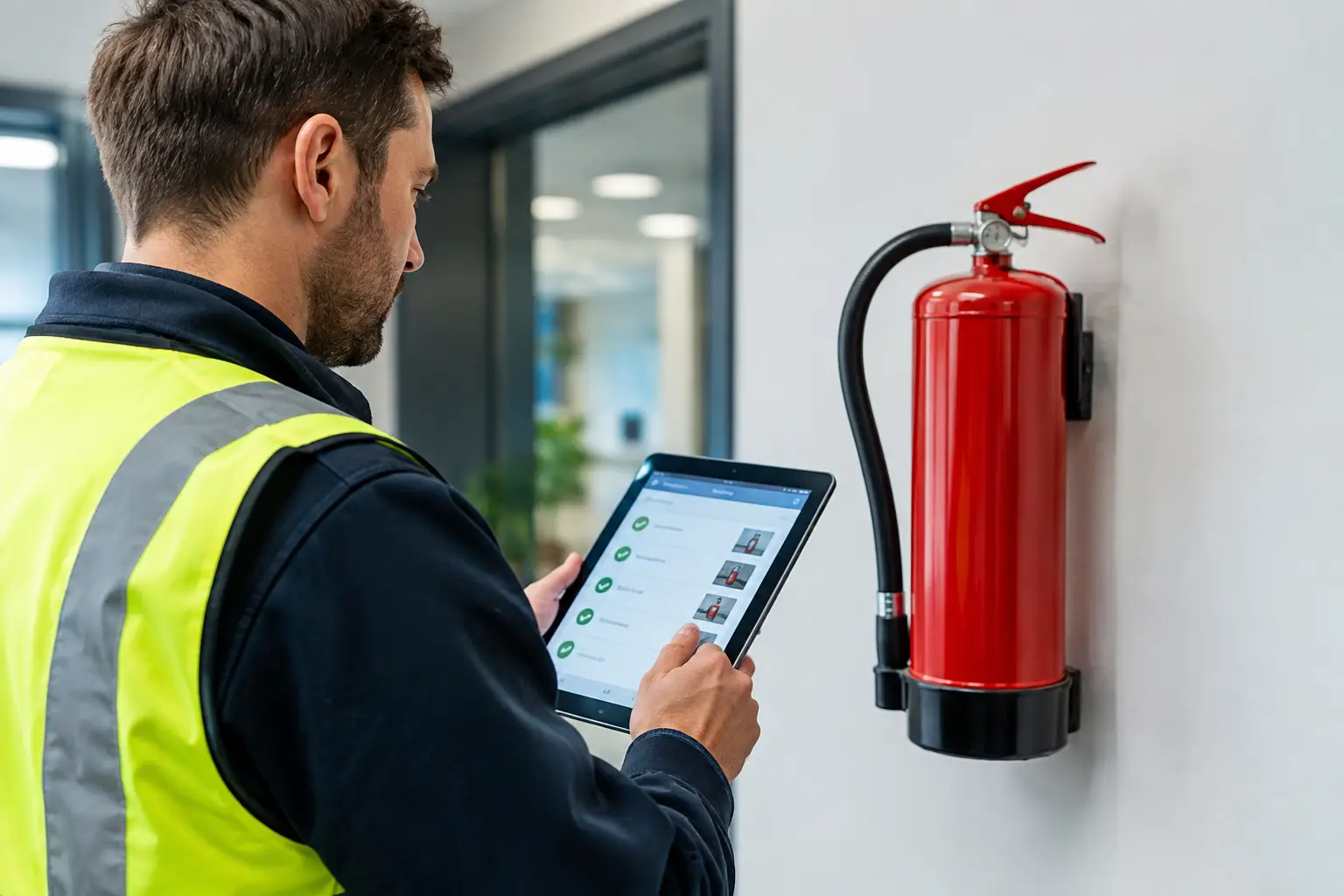
A fire engineer has completed a full day across three sites. The inspection findings are clear, but the job is not finished until the asset records are updated, defects are classified, evidence is attached and a professional certificate reaches the client. That is where fire inspection apps compared on a feature list can look very similar, while performing very differently in day-to-day operations.
For UK inspection firms, the right system is not simply a digital checklist. It needs to control recurring compliance work across client portfolios, support engineers in poor-signal plant rooms and record the evidence needed when a client, insurer or auditor asks for proof. The decision should start with your operating model: the fire disciplines you deliver, the size of the asset estate and the volume of certificates your team must issue each month.
Fire inspection apps compared: what should firms assess?
Most products fall into one of three categories. Basic form builders digitise inspection sheets quickly and can be useful for a small team with a narrow service offering. General field-service platforms are stronger on job allocation, timesheets and customer communications, but may require significant configuration to reflect fire safety workflows. Purpose-built compliance platforms are designed to connect assets, inspection outcomes, corrective actions, certificates and future due dates.
The best fit depends on what is creating friction in your business. If engineers are mainly re-keying handwritten forms, a basic digital form may deliver an immediate improvement. If the real issue is missed annual visits, inconsistent defect reporting, incomplete asset histories and slow certificate production, a form alone will move the problem downstream.
A practical comparison should test the full path from booking to audit trail. Can an administrator create a planned inspection programme by site and asset type? Can the engineer see the correct asset register on mobile? Can they record condition, defects, photographs and signatures without a connection? Can the office review and issue a certificate without rebuilding the report in another system? If any answer is no, the firm is likely to retain spreadsheets or manual administration alongside the app.
Start with the fire services you actually provide
“Fire inspection” covers several distinct workflows. A fire extinguisher service under BS 5306-3 has different inspection points, defect categories and service intervals from emergency lighting testing under BS 5266. Fire alarm servicing and inspection requires its own equipment hierarchy, test records and documentation approach, while fire door inspections may require detailed component-level findings, photographs and remedial recommendations.
Generic templates can capture observations, but they often fail when engineers need consistent, discipline-specific outcomes. A useful platform should allow your team to standardise the language used in reports. For example, a defect should be selected from a controlled catalogue, carry an appropriate severity or status, link to the relevant asset and appear correctly in both the engineer record and client certificate.
This matters commercially as well as technically. Standardised inspection outcomes make it easier to quote remedials, identify repeat issues and show clients where risk is concentrated across a multi-site estate. Free-text notes have a place for engineering judgement, but they should not be the only source of operational data.
Assess the depth of the asset register
An app that stores a site name and an uploaded PDF is not an asset management system. For recurring fire safety work, each relevant item should have a unique record, location, service history, status and next inspection date. Depending on the discipline, the record may also need manufacturer details, model, serial number, installation information and associated evidence.
Ask how assets are created and maintained. Engineers should be able to find the right extinguisher, panel, luminaire or door quickly, ideally through a searchable register, QR code, tag or mapped location. They also need a controlled way to add missing assets and flag discrepancies found on site.
Asset history is where the long-term value sits. A client may ask why an item has been condemned, whether a fault is recurring or when a previous recommendation was raised. The system should show a traceable chain of inspections, defects, photographs, actions and certificates against that individual asset. Without this, each visit starts too close to zero.
Mobile performance is a field requirement, not a bonus
Inspection software is frequently sold from an office perspective. Your engineers will judge it in basements, risers, distribution rooms and remote sites. A slow mobile workflow creates rushed records, workarounds and resistance to adoption.
Offline capability deserves particular scrutiny. It should not just allow an engineer to view a job without reception. They need to complete inspections, capture photographs, record signatures and save findings locally, with reliable synchronisation once a connection returns. Test this during a trial rather than accepting a broad claim that the app works offline.
The interface should also reduce duplicate entry. When an engineer selects an asset, its core details should already be present. When they raise a defect, the system should populate the relevant context and retain the evidence alongside the finding. Small savings at each asset become substantial across hundreds of inspections per week.
Compare certificate generation and audit evidence
A polished PDF is useful, but certificate generation should be more than document production. The issued record needs to reflect the actual inspection data, identify the site and assets covered, include relevant observations and signatures, and be controlled after issue. If an amendment is required, the system should retain a clear version history rather than silently overwriting the original record.
Audit-ready evidence is equally important. Look for timestamps, user attribution, photographs, signatures and a clear record of when the certificate was generated and issued. The platform should make it straightforward to retrieve the supporting evidence for a particular job, asset or client site.
Be cautious with systems that treat certificates as detached attachments. That approach may be workable for occasional reports, but it makes portfolio reporting, defect tracking and renewal planning far harder. The strongest workflows keep the certificate connected to the job, inspection results, asset register and corrective actions.
Scheduling must support recurring compliance work
Fire inspection firms do not run on one-off jobs alone. The operational challenge is managing annual, quarterly, monthly or otherwise planned cycles across multiple contracts and sites. Software should create future work from service rules, provide clear due-date visibility and allow the office to allocate engineers based on competence, location and capacity.
The detail matters. Can one site have several service disciplines with different frequencies? Can a job be split across visits when the estate is large? Can incomplete work be returned to the schedule without losing what has already been recorded? Can the team see overdue work and certificates awaiting review separately?
A well-connected schedule also helps protect margin. When job data, asset counts, engineer time and defects are visible in one place, managers can spot under-scoped contracts, recurring access issues and visits that consistently take longer than planned. A fire inspection app should improve delivery control, not merely make the calendar look tidier.
Use a weighted comparison, not a generic score
A supplier demonstration can make almost any platform appear capable. Give each shortlisted option a weighted score against the areas that matter to your firm, then ask suppliers to demonstrate real scenarios using your own sample site data.
| Assessment area | What good looks like | | --- | --- | | Fire workflow fit | Configurable, discipline-specific inspections and controlled defect catalogues | | Asset control | Unique assets, full history, location data and easy field updates | | Field usability | Fast mobile workflow, offline completion and dependable synchronisation | | Evidence and certificates | Signatures, timestamps, photos, version control and professional outputs | | Operational control | Recurring schedules, job allocation, status visibility and remedial follow-up | | Commercial fit | Clear per-user costs, practical onboarding and scope to add disciplines |
Weight the categories honestly. A firm servicing 20,000 extinguishers across national contracts should place more value on asset management, bulk scheduling and field speed than a business completing occasional fire risk assessments. A growing multi-discipline provider may prioritise whether the platform can also support electrical, gas, water or lifting inspection workflows without adding another disconnected system.
Plan for adoption before signing
The most capable platform will fail if your data is inconsistent and your engineers do not trust the field workflow. Start with a defined rollout: cleanse core client and site records, agree asset naming conventions, standardise defect categories and build approved certificate formats. Pilot with a representative contract, not the easiest site in the portfolio.
CertFlow is designed around this connected model, combining UK compliance workflows, asset records, mobile inspections, certificate production and audit evidence in one operating system. The value is not simply replacing paper. It is giving engineers and operations teams one reliable record of what was inspected, what was found and what must happen next.
Choose the platform that reflects how your firm works at 7am on a busy service day, not how polished its dashboard looks in a sales demonstration. If engineers can complete accurate inspections once, and the office can turn that work into controlled evidence without chasing paperwork, you have built a stronger foundation for compliance and growth.