
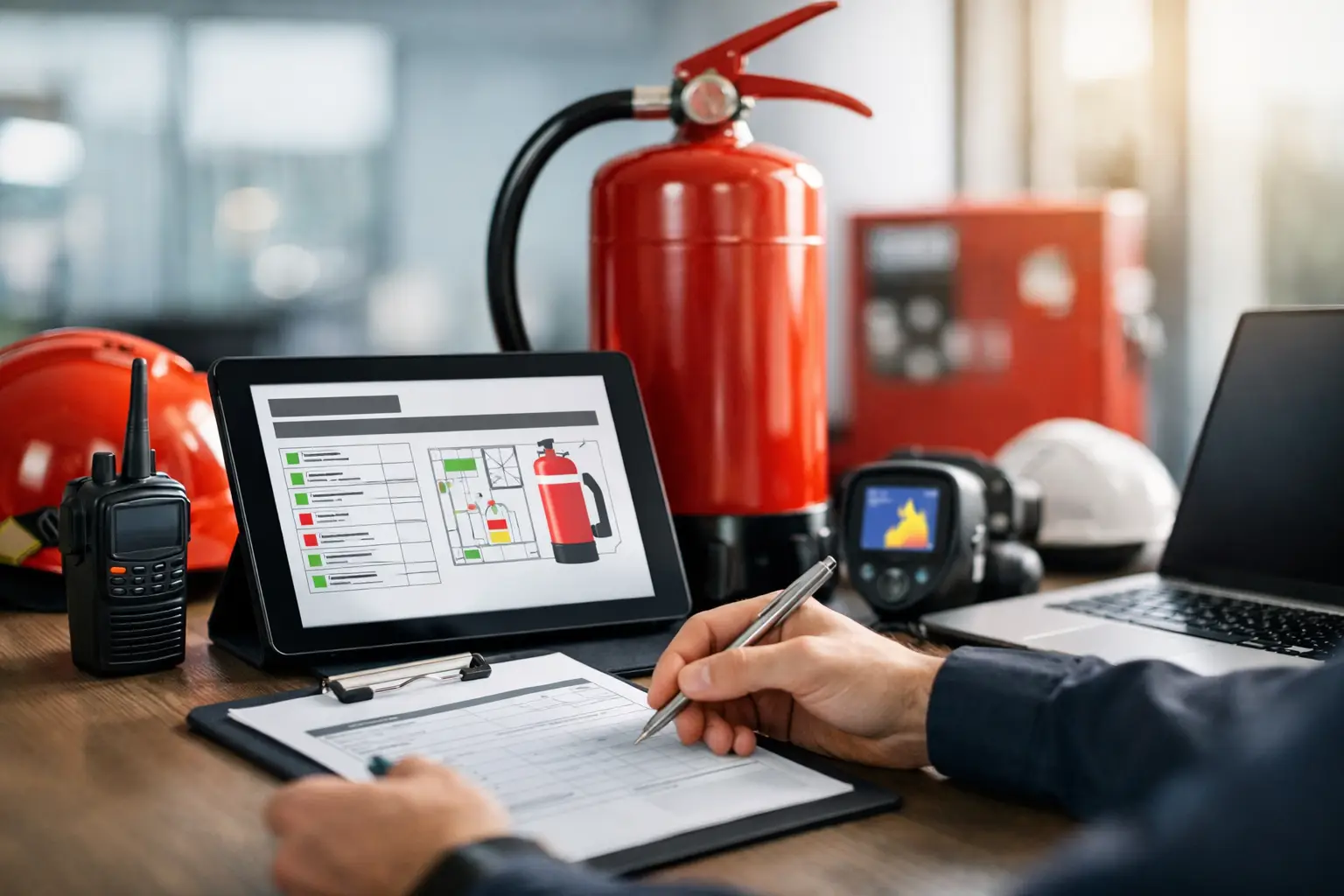
A fire extinguisher service record, emergency lighting test certificate or fire door inspection report is only useful when the client can trust its evidence, find it quickly and act on its defects. That is the practical standard by which the top fire safety reporting tools should be judged. For UK inspection firms, the question is not simply whether an app can produce a PDF. It is whether it controls the full process from asset identification and engineer attendance through to remedial actions, client reporting and the next scheduled visit.
What a fire safety reporting tool must control
Fire safety work produces a high volume of repeatable, asset-led evidence. A single site may contain extinguishers, fire doors, emergency luminaires, alarm devices, signage and fire stopping measures, each with different inspection frequencies, test methods and report outputs. Managing that estate through paper forms or separate spreadsheets creates predictable risk: assets go missing, defect wording varies between engineers, certificates are delayed and inspection dates are missed.
A suitable system should start with a structured asset register. Engineers need to identify the correct asset on site, confirm its location, record the inspection outcome and capture supporting evidence without rebuilding the same information at every visit. Site plans, QR codes or barcodes can reduce ambiguity, particularly across multi-storey buildings, schools, care settings and retail portfolios where identical assets are spread across many locations.
The reporting workflow must also reflect the work actually being completed. A fire extinguisher inspection is not a fire door survey, and neither should be forced into a generic checklist with a few editable fields. Look for templates that allow disciplined inspection points, standard defect catalogues, pass or fail outcomes, photographs, comments and clear recommendations. That consistency protects technical quality while reducing the time engineers spend writing repetitive narrative.
The top fire safety reporting tools: what separates them
The strongest platforms generally fall into three groups: generic form builders, single-discipline fire apps and integrated compliance operating systems. Each can be appropriate, but their limitations are different.
Generic forms and field-service apps
Generic mobile form tools are often the quickest route away from paper. They can capture photographs, signatures and basic checklists, and may suit a small contractor with a narrow range of reports. Their weakness appears as the inspection volume grows. Asset histories, recurring statutory work, defect tracking, certificate issue control and customer-specific reporting often sit outside the app or require manual workarounds.
That may be acceptable for ad hoc jobs. It becomes expensive when office teams are rekeying site data, chasing engineers for missing information or reconciling inspections against spreadsheets. A form is not, by itself, an asset management and compliance workflow.
Fire-specific reporting software
Fire-focused products can offer useful inspection templates and sector terminology from the outset. For firms primarily servicing extinguishers, alarms, emergency lighting or fire doors, this can be a meaningful improvement over a broad field-service platform. The key test is whether the software supports the mix of services the business intends to sell and deliver over the next few years.
A firm that also provides electrical testing, water hygiene, gas, HVAC or general health and safety inspections may find itself operating separate systems by discipline. That fragments client data and adds administration just as the business scales. It can also make account management harder, since one customer may receive several unrelated reports, portals and service schedules.
Integrated inspection and compliance platforms
An integrated platform is designed around the operating model of an inspection firm rather than a single report type. The better systems combine asset registers, job scheduling, mobile inspection workflows, certificate generation, defect management and audit evidence. This is the most suitable approach for businesses managing recurring programmes across sites and disciplines.
The trade-off is that implementation requires more structure. Asset data needs cleansing, templates need agreement and engineers need consistent working practices. That is not a disadvantage when the platform is configured well. It is the work that turns inconsistent field activity into a controlled, repeatable service operation.
Reporting features that matter in the field
Mobile usability should be treated as a technical requirement, not a sales feature. Engineers may be in plant rooms, basements, riser cupboards or remote sites with poor signal. Offline capability allows inspections to continue, with records synchronised when connectivity returns. Without it, teams revert to notes, photographs on personal devices and later re-entry - precisely the gaps reporting software should remove.
Evidence capture must be traceable. A defensible record includes who carried out the inspection, when it was completed, the relevant asset or location, the result, the defect classification and any supporting photographs. Timestamps and signatures provide further assurance. For higher-risk findings, the system should make it easy to record immediate action, notify the relevant contact and retain the history of closure.
Standardised defects are equally valuable. They help engineers describe common findings consistently, whether an extinguisher is obstructed, an emergency luminaire has failed its functional test or a fire door has damaged seals. They also improve the commercial process. Clear defect descriptions, priorities and remedial recommendations give the office a reliable basis for quotations and follow-up works.
Report production is where many tools either save time or create another bottleneck. A professional client-facing certificate should be generated from approved data, not manually assembled in Word after the engineer leaves site. It should present asset details, results, defects, photographic evidence, attendance details and any limitations in a format appropriate to the service. The client should be able to understand what requires action without interpreting engineer shorthand.
Align reporting to the applicable standard
Reporting software should support compliance work, not claim to determine compliance automatically. The competent person remains responsible for applying the correct inspection method, scope and professional judgement.
For many UK fire safety contractors, relevant references may include BS 5306 for portable fire extinguishers, BS 5266-1 for emergency lighting and BS 5839-1 for fire detection and fire alarm systems. Fire door inspection requirements and reporting expectations may also be shaped by the building type, client policy, risk assessment and applicable legislation. In England and Wales, the Regulatory Reform (Fire Safety) Order 2005 remains central to the responsible person's duties, although service providers must understand where their role begins and ends.
The practical value of a system lies in making the required evidence repeatable. It should allow your technical team to maintain approved templates, inspection frequencies, terminology and defect classifications centrally. Engineers then work from the current controlled version rather than an old form stored on a handset or in a van.
Questions to ask before choosing a platform
Before booking a demonstration, map one real customer programme from enquiry to renewal. Include the number of sites, assets, inspection types, engineers, certificates, defects and remedial quotations involved. This exposes whether a tool handles the whole workflow or only the inspection screen.
Ask how the system manages asset history when equipment is replaced, moved or decommissioned. Check whether multiple service disciplines can share the same client and site records. Establish how overdue inspections are flagged, how defects are assigned and closed, and whether managers can see outstanding work across the contract.
Also inspect the report outputs closely. Can your business apply its own approved wording and branding? Can a report distinguish observations from urgent defects? Can the client receive a clear asset schedule and evidence pack? Most importantly, can you retrieve a complete audit trail months later without searching emails, shared drives and paper folders?
For growing firms, commercial control matters too. A reporting tool should not leave job completion, invoicing support and renewal scheduling in separate systems. When inspection results, remedial opportunities and future visits remain connected, the business can respond faster and protect recurring revenue.
A practical choice for multi-discipline inspection firms
CertFlow is built for this broader inspection workflow. Its UK compliance focus supports asset-based reporting across fire safety and other regulated disciplines, while mobile and offline workflows help engineers capture evidence at the point of inspection. Controlled templates, defect catalogues, certificates, scheduling and traceable records sit in one operating system, reducing the hand-offs that slow down report issue.
The right choice will depend on the services you deliver, the maturity of your asset data and the reporting standard your clients expect. A small contractor may prioritise speed and simplicity. A business serving estates, facilities providers or national portfolios should prioritise traceability, repeatable workflows and the ability to manage every inspection cycle from one reliable record.
Choose the system that makes the correct process the easiest process for engineers to follow. When evidence is captured properly on site and reports are ready without office reconstruction, compliance becomes easier to prove and far easier to run commercially.